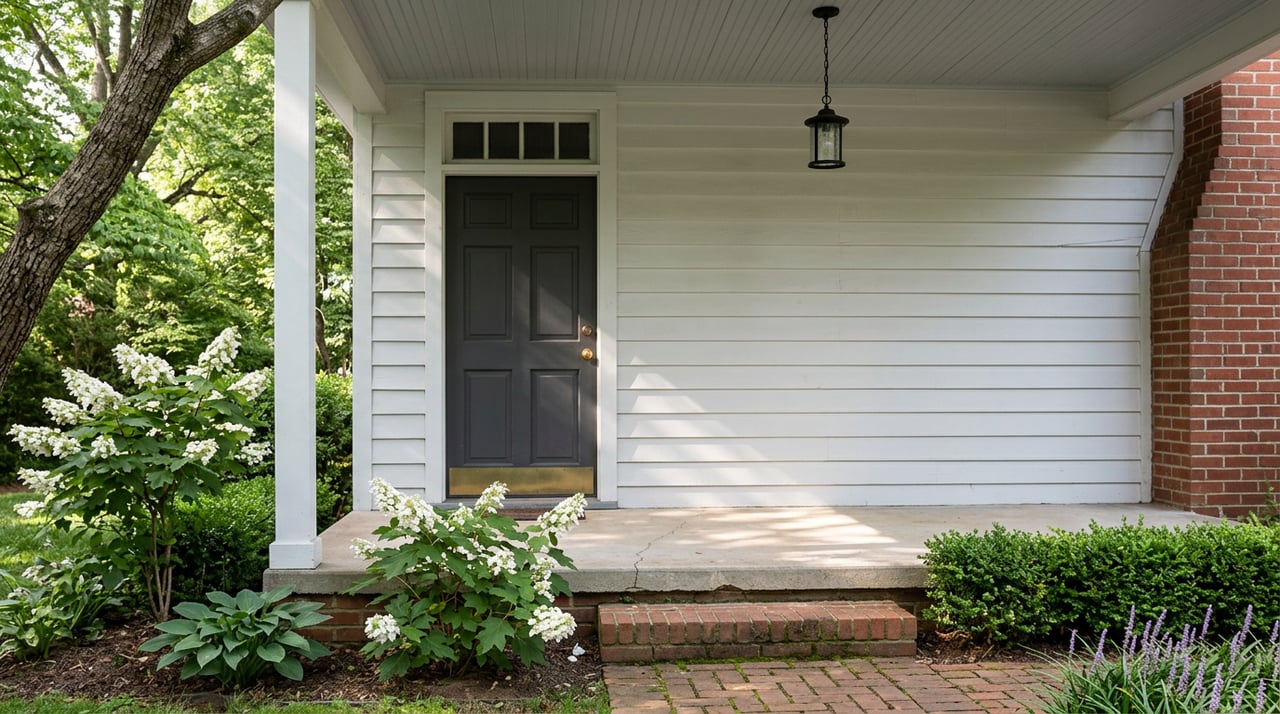
Selling an Oak Ridge Alphabet House: What the Cemesto Inspection Actually Turns Up
July 16, 2026
July 16, 2026
A buyer walks into a 1943 Type B on Outer Drive, loves the porch, loves the fireplace, writes an offer above list. Two weeks later the deal is on life support because the inspector spent forty minutes in the crawl space and ten seconds glancing at the exterior panels.
That order of operations is the whole story of selling a cemesto in Oak Ridge, and most sellers get it backwards.
The panels are not the friction. The wood is.
The cemesto exterior panels themselves are not the issue. Termites do not eat concrete or asbestos composite. The risk factor is the crawl space, the 80-year-old wood sill plate, the original floor joists, and the fact that wartime construction did not prioritize termite-resistant detailing. The cement-asbestos board that gives these houses their name is stable, non-friable, and in most surviving units already sealed inside newer siding. What sinks a cemesto contract is what sits underneath the panels, and what a Tennessee seller has to say about it in writing.
If you list without a plan for both, you concede price twice: once in repair negotiations, once in days on market.
The buyer's appraiser will pull comps by type, so you should list by type. Around 3,000 prefabricated homes were built in Oak Ridge with the help of Skidmore, Owings & Merrill, in more than 20 different layouts often identified by letters. The smallest style was the Type A with just two bedrooms; Type B was larger and rectangular; Type C had an L shape; and Type D became a precursor for the American ranch-style home.
The F-house is 1,620 square feet with three bedrooms, and there are far fewer of them than D-houses. The letter E was reserved for four-unit apartment buildings at the edges of residential neighborhoods. Beyond the cemestos, Types A, B, C, S, and V Flat-Top designs added another vocabulary of shapes to the same streets.
The point of the alphabet is not trivia. A well-preserved D with an original fireplace and a documented crawl-space treatment history is a different listing than a modified C where two owners have papered over the sill plate. A Type B-1 sits on display at the American Museum of Science and Energy, and it is worth an hour of a seller's time to walk it and photograph the details a buyer will compare their own house to.
Sellers panic about the word asbestos. Buyers' inspectors, the good ones, do not.
Asbestos is safe and legal in homes if it is intact and can be left undisturbed. Particularly in cementious form such as in the outer layers of cemesto board, the material, if undamaged, is not friable. A large percentage of the original wartime units survive, though altered by their owners in a variety of ways, and in most cases the cemesto panels are sealed inside the interior and exterior wall siding of other materials.
That is the answer to give an anxious buyer, and it is also the answer the buyer's inspector is likely to write into the report. What you should never do is cut, sand, or drill an exposed panel to "improve" it before listing. Intact panels are a non-issue. Damaged panels are a remediation line item.
Everything that stops a cemesto closing lives below the floor. Here is what a competent Oak Ridge inspector is looking for, and what a seller should have already handled:
A current termite letter, a crawl-space photo set, and a receipt for any moisture-barrier work are worth more to a cemesto listing than any cosmetic upgrade above the floor.
Every cemesto listing pulls in a federal form and a state form. Neither is optional, and both are places where sellers quietly hurt themselves by answering carelessly.
The federal form is the lead-based paint disclosure. Under the Residential Lead-Based Paint Hazard Reduction Act of 1992, sellers of homes built before 1978 must give buyers the EPA's Protect Your Family From Lead in Your Home pamphlet, disclose any known lead-based paint or hazards, provide any records or reports they have, include a Lead Warning Statement in the sales contract, and allow buyers a 10-day period to conduct a lead-based paint inspection or risk assessment. That 10-day window is a real clock. If you hand the disclosure over the day the contract is signed, you have added ten days to the earliest possible closing.
The state form is the Tennessee Residential Property Condition Disclosure. The standard Tennessee disclosure form asks about asbestos, radon, underground storage tanks, and other environmental hazards, and regardless of the disclosure versus disclaimer choice, sellers must comply with federal lead-based paint disclosure for pre-1978 homes. The Tennessee Residential Property Disclosure Act, codified at T.C.A. § 66-5-210, states that anyone transferring title to residential real property must provide information about the condition of the property, and the completed form constitutes that disclosure by the seller.
The right way to answer the asbestos question on the Tennessee form is with a fact, not a guess. If your house is an original cemesto, the exterior walls contain cement-asbestos board. Say so. Attach a one-page addendum that explains the panel is intact and non-friable and that no interior remediation has been performed. Most states require asbestos disclosure only if the seller has actual knowledge of asbestos. In Oak Ridge, if you own an alphabet house, you have actual knowledge.
The 37830 market in mid-2026 is a market of two distributions sitting on top of each other, and cemesto sellers who read the headline number without splitting it will misprice their listing.
The headline is straightforward. Over the three months ending May 2026, the median sale price in Oak Ridge was $395,000, up 14.4% from the same period a year earlier, at a median $182 per square foot, with homes selling after 52 days on the market. In June 2026, homes were listed at a median of $394,000, and homes for sale spent a median of 42 days on market.
Look at the same ZIP through a range instead of a median and the picture changes. Roughly 677 homes are actively listed in ZIP 37830, with list prices spanning from about $63,000 to $1,590,000. That gap is the alphabet house market and the newer Turnpike-adjacent and Preserve-style market coexisting in one dataset. A well-prepped Type D with clean disclosures and a documented crawl space is not competing with a $1.5M new build, and it is not competing with the $63K parcels either. It is competing with other alphabet houses whose sellers have or have not done this work.
That is where a pre-listing termite letter and a legible cemesto addendum move the needle. On a 52-day median market, a cemesto with the paperwork already in the folder can shave the ten-day federal lead window off the front of the transaction and remove the biggest inspection contingency from the middle of it.
Handled in this order, most cemesto listings avoid the two-week inspection stall:
That is the sequence a listing broker who knows this housing stock will run before the sign goes in the yard.
Do I have to remove the cemesto panels to sell? No. Intact panels are legally saleable and are what most surviving units still have, usually sealed inside newer siding.
Does the federal lead-paint 10-day period always apply? Yes for pre-1978 housing, and every original alphabet house is pre-1978. Buyers can waive it in writing but sellers cannot skip offering it.
Can I use the Tennessee "as-is" disclaimer instead of the disclosure form? Sellers may provide an "as-is," no representations or warranties disclaimer statement in lieu of the Disclosure form only if the buyer waives the right to the required disclosure. On a cemesto, that waiver is rare because buyers want the environmental section answered.
Are these houses considered historic? The cemesto alphabet houses were not built to be temporary, and the historical evidence supports that. Woodland and Scarboro sit inside a documented National Register district, and Jackson Square remains the SOM-designed original town center. Historic status can affect exterior modifications; it does not affect the sale itself.
Selling one of the 3,000 houses that built the Secret City is a specific transaction, not a generic one. If you own an alphabet house and you are thinking about listing in the back half of 2026, Kathy May-Martin and the team at Coldwell Banker Jim Henry & Associates will walk your crawl space, price your type against the right comps, and have the disclosure packet ready before your first showing. Schedule Your Consultation to start the pre-listing work while the summer market is still moving.

Kathy May-Martin
With over 31 years in the real estate industry, Kathy May-Martin brings a wealth of knowledge to her clients. Her approach is driven by a commitment to staying informed and adapting to industry changes to provide the best service possible. Kathy's dedication to surpassing client expectations is evident in her attention to detail, ensuring every client benefits from her expertise. Her comprehensive marketing strategies are designed to help sellers achieve quick, profitable sales, leveraging cutting-edge resources for maximum exposure.
Stay up to date on the latest real estate trends.

Fishing, Boating, and Waterfront Living on Watts Bar Lake.

On the Village’s Eight Areas and Three Championship Golf Courses.
One way to set the stage for a successful buying and selling process is to listen to May-Martin clients, find out what their priorities are, and then help them prioritize that list based on the state of the market.

410 N Kentucky St
Kingston TN 37763