In Lenoir City, Home Construction Is Booming. Apartments Are on Hold.
August 13, 2026
August 13, 2026
"Growth is inevitable, but we want to figure out ways that we can manage it," Lenoir City Administrator Amber Scott Kelso said this year, describing a town that has grown roughly 50 percent over the past decade, most of it in just the last five years. That single quote explains more about this market than any median price figure does. Lenoir City is not deciding whether to grow. It is deciding what kind of growth to allow, and for more than two years, one entire category of housing has not made the list.
If you are comparing Lenoir City to Kingston, Rockwood, or the lake towns further west, you have probably already seen the headline numbers: strong permit activity, new subdivisions with names like Luna Ridge and Avalon, a housing stock that looks, from the outside, like a town in the middle of a boom. What those numbers don't show is that the boom has a shape, and the shape was set by a City Council vote.
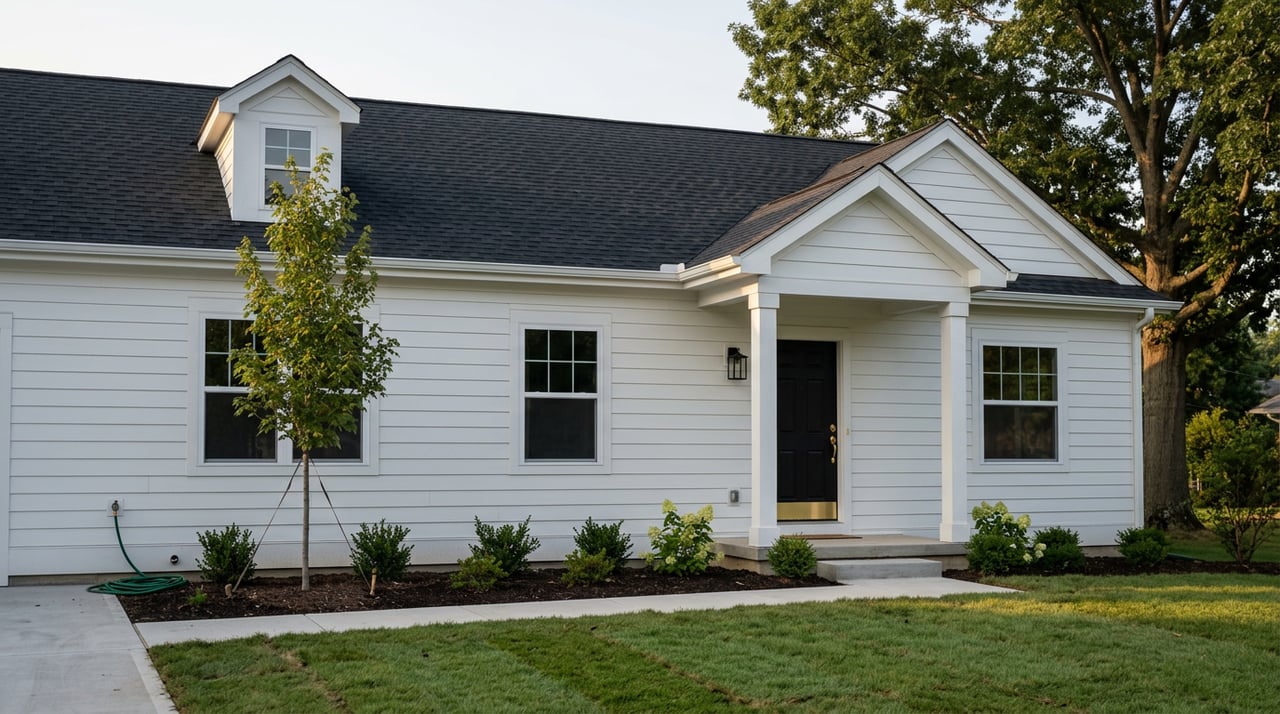
The most recent full year of Census Bureau building permit data, covering 2024, shows Lenoir City issued 163 new housing unit permits, a 32.5 percent jump from the prior year. On paper, that reads as a town outbuilding its neighbors. Look closer and the picture narrows. Those units carried an average construction value of $317,000, about 22 percent above the Loudon County average of $259,000 per unit. Fewer than 3 percent of the units permitted were multi-family. Nearly everything else was single-family detached.
That combination, more permits, higher price per unit, almost no multi-family, is not a coincidence of the market. It is the direct, traceable result of a policy the city has renewed three times.
Lenoir City has paused new "apartment style" residential construction since June 2024. The council has extended that pause every year since, most recently on February 23, 2026, when a 4-0 vote pushed the ban into its third consecutive year, effective through at least June 2027, according to the Loudon County News-Herald. Town Creek Village, an existing apartment complex the paper has used as its visual shorthand for the ordinance, is effectively the last of its kind for now. Nothing like it can currently break ground inside city limits.
The ordinance has also gotten stricter with each renewal. When it first passed, developers could still qualify for an exception if a site had already cleared certain planning hurdles. By the 2026 rewrite, the council removed every exemption. "There was no need to have any exceptions in the ordinance," City Attorney Walter Johnson told the council at the January reading. The moratorium does not touch single-family subdivisions, and a proposal to extend it to duplexes was raised and dropped before the final vote, so the ban is narrowly and deliberately aimed at the multi-family product type that typically delivers the most affordable new units fastest.
That speed is exactly what officials have cited as the concern. Apartment complexes can be permitted, built, and leased in nine to eleven months, faster than the city's water, sewer, and road capacity can absorb new residents, according to Kelso's comments reported by WATE. Single-family subdivisions build out over years, giving infrastructure time to catch up. The moratorium is framed as pacing, not prohibition. But pacing that only slows one type of housing changes what gets built regardless of intent.
Infrastructure capacity is the official reason for the pause. There is also a fiscal logic running underneath it that shapes which kinds of growth the council actively courts. Council members have shown a consistent preference for commercial and industrial projects that bring in sales tax revenue from non-residents, over residential growth that adds students and service demand without a matching new revenue stream, based on public council discussion tracked through planning and budget records.
That preference showed up clearly last winter. Facing pressure to fund school expansions and a new senior center, the council put a 0.75 percentage point sales tax increase to a public vote rather than raise property taxes. Mayor Tony Aikens was explicit about why. "That's not an option," he said of a property tax increase. "I'm not for raising property taxes to build a senior citizen center. And I'm not for raising property taxes to fund the school system more." Voters rejected the sales tax increase earlier this year, according to WBIR, leaving the city without that funding path and with the same infrastructure constraints it cited for the moratorium in the first place.
Where you land relative to the city line also changes your tax bill directly. Loudon County's property tax rate for fiscal year 2026-2027 is set at $0.8602 per $100 of assessed value inside Lenoir City's corporate limits, compared to $1.0944 per $100 outside them, according to the county's FY2027 budget resolution. For a buyer choosing between a home just inside the city line and one just outside it, that rate difference is a real, recurring number, not a marketing detail.
Underneath the tax politics sits a longer-running dispute over who pays for the schools that Lenoir City's own growth is filling up. The city currently receives 12.5 percent of Loudon County's Adequate Facilities Tax, a construction-based tax collected on new development, with an additional 2.5 percent routed to an education capital fund. That 15 percent split, worth roughly $200,000 a year to Lenoir City Schools today, was not always structured this way. Before 2021, Lenoir City Schools received the full 15 percent outright, worth about $400,000 a year, until the Loudon County Commission moved to eliminate or heavily reduce that share. Mayor Aikens only preserved a version of the funding by withholding paperwork and negotiating a new four-year agreement, according to reporting in the News-Herald.
That four-year agreement, struck after the 2021 standoff, was already nearing its scheduled end as of mid-2025, around the same time Loudon County was pushing forward with a new high school, Ridgeview, planned near Simpson Road and Highway 11 to absorb regional enrollment growth. When the county brought its site plan to Lenoir City's planning commission in the fall of 2025, the board denied it outright over traffic concerns, the same entitlement obstacle that has stalled residential projects, according to the Tellico Village Connection. In January of this year, Mayor Aikens publicly criticized the county's own tax increase used to fund that project, writing that "the Loudon County Commission recently increased your taxes to build a new county high school that is not needed." Two governments, one growth problem, and neither side eager to be the one who pays for it.
None of this has slowed single-family construction. New listings in mid-2026 show what's actually filling that pipeline:
Every one of those is a single-family product. None of them is the fast-to-build, lower-cost rental or entry-level unit that a moratorium-free market would typically add first. As of early August 2026, the median list price across active Lenoir City listings sat at $561,950, with homes averaging $321.84 per square foot, figures consistent with a market where the newest supply is concentrated at the upper end.
The mechanism most likely to change this is already underway. Lenoir City hired the engineering firm Kimley-Horn under a $79,750 contract to write the city's first comprehensive land use plan in more than 20 years, according to Jack Qualls of the Loudon County Economic Development Agency, who told the council in January that the process will include public workshops and a community survey and is expected to directly address housing and demographic growth. City leaders have told WATE they expect the study to be finished by fall of 2026, which puts a real, near-term deadline on the question of whether the multi-family pause becomes a permanent zoning posture or a temporary bridge to something more deliberate.
For anyone weighing Lenoir City against other East Tennessee towns, that plan is the number worth watching, more than any single month's median price. It will determine whether the housing mix stays tilted toward golf-community single-family product or opens back up to the kind of mid-tier and rental supply the moratorium has held in place since 2024.
Does the moratorium affect duplexes or single-family neighborhoods? No. The ban applies specifically to apartment-style multi-family buildings. Single-family subdivisions have continued approving and building throughout the moratorium, and a proposal to extend the rule to duplexes was dropped before the final 2026 vote.
When could the moratorium lift? There's no set date. It runs through at least June 2027 under the current extension, and the comprehensive land use plan due this fall is expected to shape whatever policy replaces it.
Does this affect home values right now? It affects supply mix more than it affects any single price point. With new multi-family supply essentially paused, buyers looking at Lenoir City are choosing almost entirely from single-family inventory, which keeps competition concentrated in that category rather than spread across housing types.
If you're trying to figure out what a town's zoning fights actually mean for your search, that's a conversation worth having with someone who follows these council votes as closely as the listings. Kathy May-Martin has spent more than three decades reading exactly this kind of local detail for buyers and sellers across Kingston and the East Tennessee corridor. Schedule Your Consultation to talk through what Lenoir City's next zoning decision could mean for your timeline.

Kathy May-Martin
With over 31 years in the real estate industry, Kathy May-Martin brings a wealth of knowledge to her clients. Her approach is driven by a commitment to staying informed and adapting to industry changes to provide the best service possible. Kathy's dedication to surpassing client expectations is evident in her attention to detail, ensuring every client benefits from her expertise. Her comprehensive marketing strategies are designed to help sellers achieve quick, profitable sales, leveraging cutting-edge resources for maximum exposure.
Stay up to date on the latest real estate trends.


A Buyer's Guide to Mortgages for Luxury Buyers in East Tennessee.

Discovering the Lifestyle Behind Golf and Luxury Living at Oak Ridge Country Club.

How to Pick the Style You’ll Love in Kingston, Tennessee.

What to Know About Living Near Fox Den Country Club and Its Farragut Setting.

Why Many People Are Choosing to Retire in Kingston, Tennessee.
Designing an Outdoor Living Space That Makes the Most of Watts Bar Lake.
One way to set the stage for a successful buying and selling process is to listen to May-Martin clients, find out what their priorities are, and then help them prioritize that list based on the state of the market.

410 N Kentucky St
Kingston TN 37763